
Introduction: Why is the Indus Water Treaty important?
The Indus Water Treaty is a historic and water agreement between India and Pakistan, which has not only been helpful in maintaining relations between these two countries, but it is also considered one of the most successful international water agreements in the world. This treaty was signed in 1960 between the then Prime Minister of India Jawaharlal Nehru and the President of Pakistan Ayub Khan, under the mediation of the World Bank.
Both India and Pakistan are agricultural countries and their economy is largely dependent on water. After partition, when there was a dispute over the rights to the Indus river system, this treaty emerged as a peaceful solution. For the last several decades, despite many political tensions, this treaty has been followed by both the countries.

This agreement not only organizes water sharing, but it is also an example of how two opposing countries can solve such complex issues through mutual understanding and international cooperation. For this reason, the Indus Water Treaty is still considered inspirational.
What is the Indus Water Treaty? –
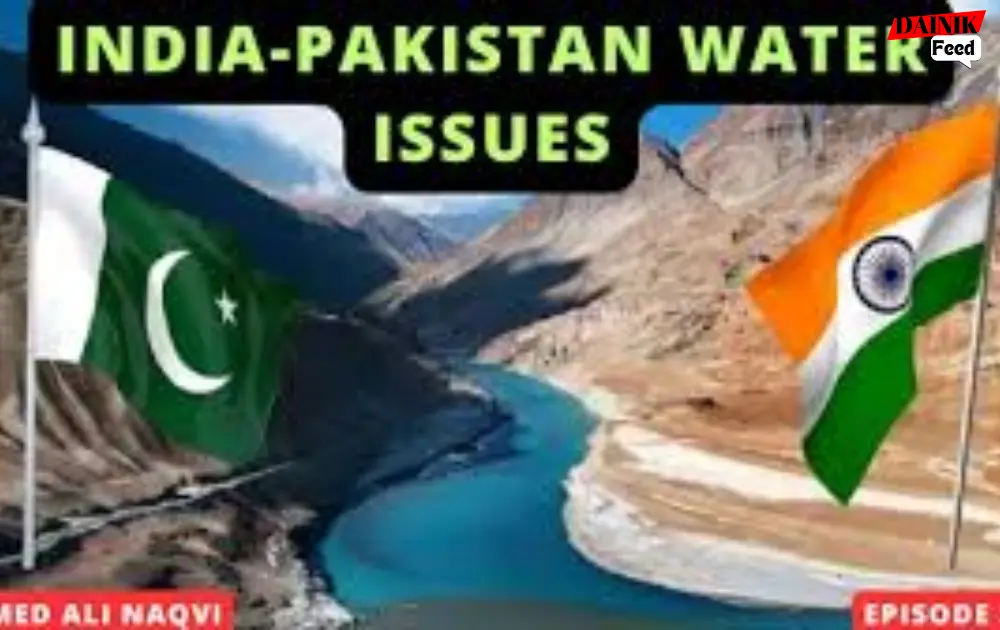
The Indus Water Treaty is a bilateral water agreement, signed between India and Pakistan on 19 September 1960. Under this treaty, the six rivers of the Indus river system have been divided into two parts. The eastern rivers — Sutlej, Ravi and Beas — were given to India, while the western rivers — Indus, Jhelum and Chenab — were given to Pakistan.
According to this treaty, India was allowed limited use of the western rivers for irrigation, power generation and domestic use, with the condition that it does not cause any harm to Pakistan. This treaty is also special because it clearly explained the water sharing between the two countries, reducing the possibility of future disputes.
The World Bank played the role of mediator in this agreement and helped both countries in implementing it. From then to today, this treaty has been implemented almost without any major interruption, which shows its strength and practicality.
Historical background of the treaty
(Water dispute started after India-Pakistan partition)
At the time of India-Pakistan partition in 1947, not only land was divided, but the division of rivers also became a big challenge. Punjab region, which was the main center of the Indus river system, was divided into two parts. This had a direct impact on the irrigation system and agriculture. Major rivers like Indus, Jhelum and Chenab flowed in Pakistan, but their main source was in India. Due to this, Pakistan feared that India could stop the water of these rivers at any time.
After the partition, a temporary water distribution system continued between the two countries for a few years, but when India stopped the water of some canals in 1948, Pakistan saw it as a serious crisis. This was the moment when both the countries felt the need for a permanent solution. In this background, the World Bank mediated and after several meetings of technical and political experts of both the countries, the ‘Indus Water Treaty’ was signed in 1960.
This treaty was not just a water sharing, but it was also a major diplomatic success at that time, when the relations between the two countries were very tense. It also played an important role in avoiding possible wars and disputes in the future.
When and how was the treaty signed?
(Main points and role of the treaty signed in 1960)
The Indus Water Treaty was signed on 19 September 1960 in Karachi, in which Prime Minister Jawaharlal Nehru from India and President Ayub Khan from Pakistan participated in the main form. The World Bank played the role of a mediator and financial partner in this treaty. This treaty was prepared after about eight years of negotiations and technical information.
During this treaty, the six rivers of the Indus river system were divided into two parts:
The eastern rivers – Sutlej, Ravi and Beas – were given full rights to India.
The western rivers – Indus, Jhelum and Chenab – were given primarily to Pakistan.
India was allowed limited use (such as irrigation, run-of-river hydropower projects, and domestic use) on the western rivers, but any such action should not have a negative impact on Pakistan’s water flow.
In addition, the Permanent Indus Commission was established between the two countries, which meets twice a year and resolves any dispute if it arises.
A special feature of this treaty is that it has remained effective even after three wars and many political tensions. It is considered a successful model for peaceful resolution of water disputes at the international level.
Role of the World Bank: An impartial mediator
The role of the World Bank has been very important in successfully implementing the Indus Water Treaty. When the water dispute between India and Pakistan escalated and the two countries were unable to reach any conclusion, the World Bank played the role of a chief mediator. In the year 1951, the World Bank proposed to both the countries to move towards a technical and permanent solution, which was accepted by both the parties.
The World Bank not only played the role of an advisor, but also appointed a team of technical experts who conducted an in-depth study of the entire Indus River. On the basis of this study, a practical and equitable plan of water sharing was prepared. The World Bank also provided financial assistance for the construction of dams, canals and reservoirs that were required under the treaty.
Apart from this, the World Bank also ensured that both the countries work with mutual understanding and a peaceful solution should be found even in case of dispute. If there is disagreement on any provision of the treaty, the World Bank can also appoint a mediator or judicial expert.
In this way, the role of the World Bank was not limited to just negotiating an agreement, but it also monitored it for years and maintained impartiality. The treaty is still in force today, and a great credit for this goes to the honest, impartial and balanced role of the World Bank.
Major provisions of the Indus Water Treaty
(Which rivers were divided and how?)
The Indus Water Treaty is a historic agreement between India and Pakistan in 1960, which was made regarding the six major rivers of the Indus river system. In this treaty, some important and clear rules were set for water distribution, due to which this agreement is still effective today.
- Division of rivers:
Under the treaty, the rivers were divided into two parts:
Eastern rivers – India was given the right to use the water of Sutlej, Ravi and Beas completely.
Western rivers – Indus, Jhelum and Chenab water were mainly given to Pakistan, but India has also been allowed to use them limitedly.
- India’s rights:
India has been given limited rights on the western rivers such as irrigation, run-of-river hydroelectric projects, and domestic use, provided that it does not have any wrong effect on Pakistan’s water flow.
- Establishment of Permanent Indus Commission:
A Permanent Indus Commission was also formed between the two countries, which meets at least twice a year and maintains dialogue on all technical and administrative matters related to water.
- Dispute resolution system
The treaty also provides that if there is a disagreement on any issue, it should first be resolved through the commission. If there is no solution, then the process of resolution is adopted through an impartial expert or arbitration court.
Why the Indus Water Treaty is considered a successful agreement
The Indus Water Treaty is internationally considered a successful and permanent water agreement. This treaty has been in force for more than 60 years, and it shows that peaceful solutions are possible despite political tensions and conflicts. Despite three wars, border conflicts and many terrorist attacks between India and Pakistan, this treaty has never been canceled, which shows its strength.
Recently, after the Pulwama terrorist attack (2019) and Uri attack (2016), resentment over the Indus Water Treaty came to the fore in India. Prime Minister Narendra Modi ji said.
“Blood and water cannot flow together.” After this, India decided that it would make maximum use of the water of its share of eastern rivers, which earlier flowed towards Pakistan. For this, irrigation and water projects were rapidly taken forward.
Although the treaty was not completely canceled, India made it clear that it would make full use of its rights. This has made the treaty no longer just a document but also a strategic and diplomatic tool.
After the terrorist attack in Pahalgam, Jammu and Kashmir on 22 April 2025, which claimed the lives of 26 people, Prime Minister Narendra Modi took tough and decisive steps.
Decisions of Prime Minister Modi:
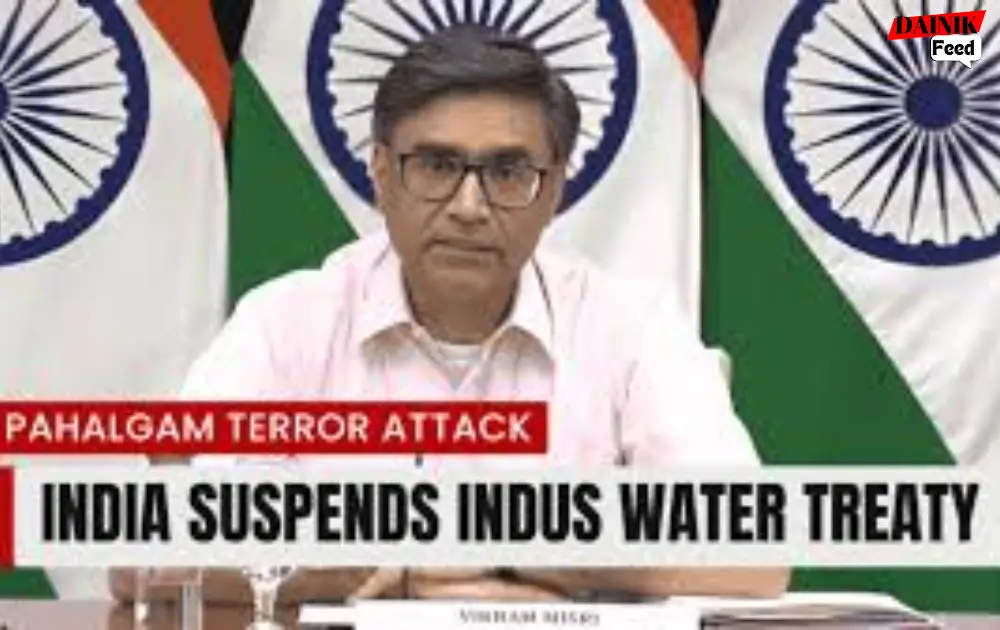
Suspension of Indus Water Treaty: The Government of India has completely suspended the 1960 Indus Water Treaty with Pakistan, affecting the water sharing arrangement between the two countries.
Curtailment of diplomatic relations: India has downgraded its diplomatic relations with Pakistan, including a reduction in the number of diplomats and withdrawal of military advisers.
Cancellation of visas of Pakistani citizens: India has canceled visas of all Pakistani citizens and also imposed a ban on travelers coming from Pakistan.
Closure of border: India has closed its land border with Pakistan, affecting trade between the two countries.
National Investigation Agency (NIA) investigation: Prime Minister Modi has sent the National Investigation Agency to the scene to thoroughly investigate the attack and bring the culprits to justice.
Prime Minister Modi condemned the attack, calling it a “cowardly and heinous” crime and vowed to ensure that the culprits are punished severely.
Following these steps, Pakistan has also responded by cancelling visas of Indian citizens, suspending trade relations and closing its airspace to Indian flights.
read more: 4 pocket friendly manali tour
Conclusion:
Indus Water Treaty – A Bridge of Peace through Water or Future Dispute?
The Indus Water Treaty is not just a water treaty, it is a bridge between India and Pakistan that has guided the two countries to move forward through dialogue and restraint for decades. This historic agreement of 1960 provided a clear division of the eastern and western rivers at a time when the two countries were divided and tensions were high.
The World Bank’s impartial mediation, the establishment of a permanent Indus Commission and a systematic process of dispute resolution made this treaty an excellent model. India got full rights over its share of rivers and Pakistan got a lifeline-like dependence on the western rivers.
However, in recent years – especially due to terrorist attacks and cross-border tensions – this treaty has also been questioned. The strong message given by Prime Minister Narendra Modi and the policy of full utilization of its water rights show that India will now use its strategic power to give a new definition to the treaty.
It would be appropriate to say that the Indus Water Treaty is relevant even today, but amid the changing geopolitical scenario and security concerns, it has become not just a water agreement but a strategic weapon.
When and between whom was the Indus Water Treaty signed?
The Indus Water Treaty was signed between India and Pakistan on 19 September 1960. It was signed by India’s Prime Minister Pandit Jawaharlal Nehru and Pakistan’s President Ayub Khan under the mediation of the World Bank.
How were the rivers divided under this treaty?
Six rivers were divided into two parts:
Eastern rivers (Sutlej, Ravi, Beas) – full rights to India.
Western rivers (Indus, Jhelum, Chenab) – main rights to Pakistan, limited use to India.
Can India cancel the Indus Water Treaty?
Technically India can cancel this treaty, but it may have to face international political pressure to do so. So far India has only decided to make maximum use of its share of water
Does the Indus Water Treaty harm Pakistan?
No, rather the treaty gave Pakistan control of its three major rivers, which have been its agriculture and lifeline. This is why Pakistan considers it in its interest.
What steps has India taken after the recent attacks?
After the 2025 Kashmir terror attack, India suspended the Indus Water Treaty, cut diplomatic ties with Pakistan, closed the border and also cancelled visas of Pakistani citizens.